
Five years ago, recycled stretch film was often seen as the budget option in the packaging industry.
It was typically associated with a few common characteristics:
- Lower prices
- Grayish appearance
- Limited stretchability
- Suitable only for low-end applications
Fast forward to 2026, and the story has completely changed.
Today, European buyers are requesting 30–50% PCR (Post-Consumer Recycled) content. Major retailers in North America are asking suppliers to disclose carbon footprint data. Even logistics companies in the Middle East are introducing sustainability targets into their procurement strategies.
In other words, recycled stretch film is no longer an alternative—it is rapidly becoming a requirement.
Ironically, while demand is increasing worldwide, manufacturers are facing an unexpected reality:
Recycled stretch film has never been more difficult to produce.
From unstable raw materials and increasingly demanding customers to tighter regulations and higher R&D costs, manufacturers are discovering that sustainability comes with a price.
So why is recycled stretch film becoming significantly harder to manufacture in 2026?
Let’s take a closer look.
The Sustainability Wave Is Reshaping the Packaging Industry
For decades, the packaging industry focused on two things:
- Cost
- Performance
Today, there is a third factor that every manufacturer must consider:
Sustainability.
Packaging buyers are asking questions that were almost unheard of a few years ago:
- What is the PCR content?
- Is the product GRS certified?
- Can you provide carbon emission data?
- Does it comply with European packaging regulations?
- What is your ESG strategy?
Ten years ago, a customer would simply ask:
“How much is it per roll?”
Today, they ask:
“Where did the material come from?”
Governments around the world are introducing regulations aimed at reducing plastic waste and promoting circular economies. As a result, packaging manufacturers are under pressure to increase the use of recycled materials.
However, there is one major problem:
Recycled materials are rarely consistent.
Unlike virgin LLDPE resin, recycled plastic behaves differently from batch to batch, making production far more complicated.
The Biggest Challenge: Inconsistent Raw Materials
Virgin resin is predictable.
Recycled resin is not.
A shipment of recycled polyethylene may contain material originating from:
- Industrial stretch film
- Retail packaging waste
- Agricultural film
- Shipping bags
- Warehouse scrap
- Production edge trim
Although all of these materials may technically be polyethylene, they differ significantly in:
- Melt flow index
- Density
- Moisture levels
- Contamination rates
- Oxidation levels
- Molecular structure
For manufacturers, every batch can feel like opening a mystery box.
Many production managers have experienced situations like this:
- Monday: Perfect machine performance.
- Wednesday: New material arrives, and film breakage increases dramatically.
- Friday: Customers complain about inconsistent quality.
The reality is simple:
Recycled materials do not have the same level of standardization as virgin materials.
This means manufacturers must invest heavily in:
- Sorting systems
- Washing technology
- Filtration equipment
- Material testing
- Supply chain management
In 2026, competitive advantage is no longer determined by who owns the biggest factory.
Instead, it depends on who can transform inconsistent materials into a reliable product.
Stretch Performance Has Become a Technical Barrier
Customers do not buy stretch film because it is plastic.
They buy it because it performs.
Key performance indicators include:
- Stretchability
- Puncture resistance
- Load retention
- Cling performance
- Transparency
- Consistency
A premium machine stretch film is often expected to achieve elongation rates of 250%–350% while maintaining excellent load stability during transportation.
This is where recycled materials create significant challenges.
Every time plastic is melted and reprocessed, its molecular chains become shorter.
Imagine stretching a rubber band repeatedly.
Eventually, it loses elasticity.
The same thing happens to recycled polyethylene.
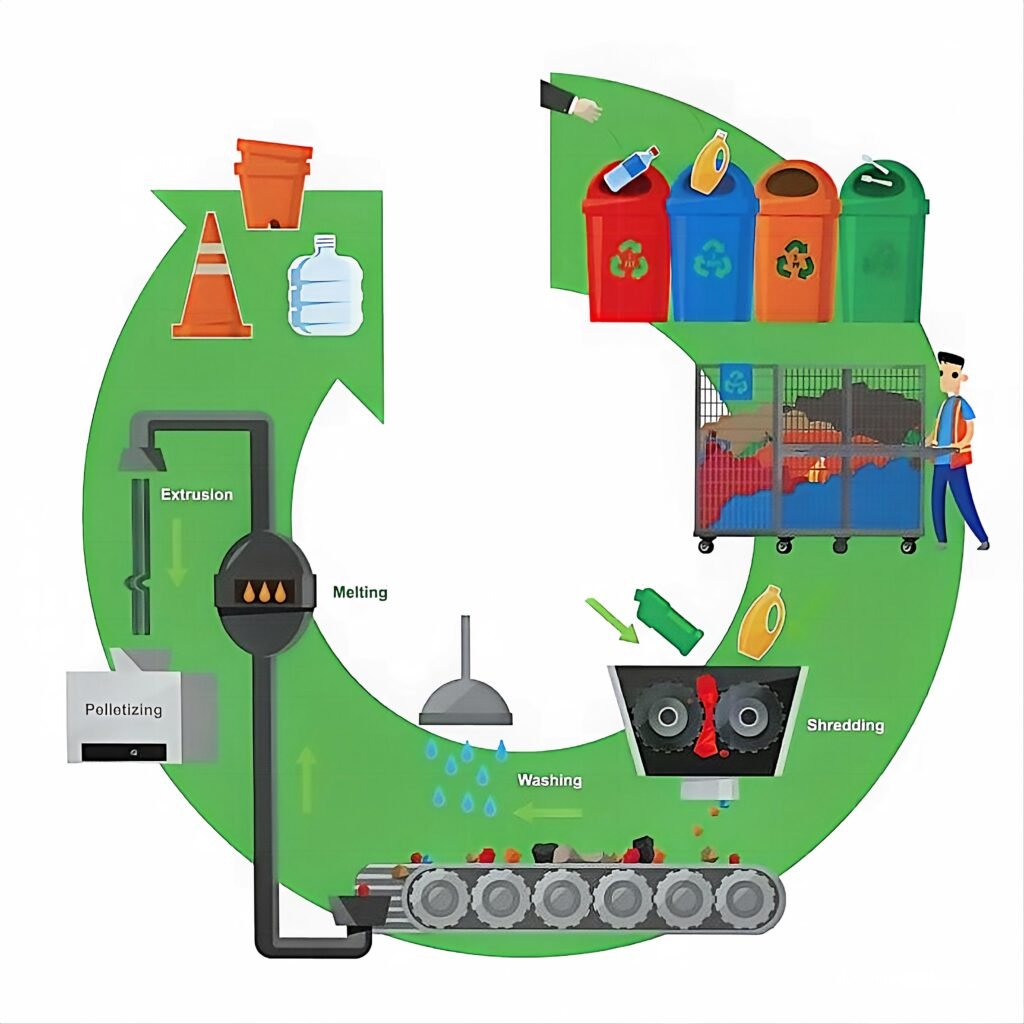
By the time recycled material has been:
- Collected
- Sorted
- Washed
- Pelletized
- Processed again
its mechanical properties have already changed.
The result?
- Reduced flexibility
- Lower puncture resistance
- Increased brittleness
- Higher breakage rates
Many manufacturers have discovered an interesting trend:
| PCR Content | Manufacturing Difficulty |
|---|---|
| 10% | Relatively easy |
| 20% | Noticeable adjustments required |
| 30% | Significant formulation changes |
| 50%+ | Extremely challenging |
This has led to a popular saying within the industry:
“Producing virgin stretch film requires machinery. Producing high-PCR stretch film requires engineers.”
Customers Want Everything at Once
Modern buyers expect recycled stretch film to be:
- More sustainable
- Less expensive
- Thinner
- Stronger
- Higher in PCR content
Essentially, they are asking manufacturers to create a product that is:
Better, greener, and cheaper—at the same time.
Unfortunately, physics does not always cooperate.
Increasing PCR content often leads to:
- Higher production costs
- Lower production efficiency
- More quality inspections
- Greater equipment wear
- Additional testing requirements
As a result, many manufacturers are realizing something unexpected:
Recycled stretch film is no longer a low-cost product.
In fact, premium PCR stretch films with certifications and stable performance can command higher prices than traditional products.
Why?
Because customers are not simply purchasing packaging anymore.
They are purchasing compliance, sustainability, and brand value.
Thickness Control Is More Important Than Ever
In stretch film manufacturing, even a one-micron variation can impact:
- Strength
- Weight
- Cost
- User experience
With recycled materials, maintaining thickness consistency becomes significantly more difficult due to unstable melt behavior.
In the past, manufacturers considered ±1 micron acceptable.
Today, many international buyers expect tolerances closer to ±0.5 microns.
This explains why more factories are investing in:
- Online thickness gauges
- Automatic dosing systems
- Intelligent temperature control
- AI quality inspection systems
- MES production management software
The future of stretch film manufacturing is increasingly data-driven.
Factories that rely solely on operator experience may struggle to compete in the coming years.
Meanwhile, manufacturers capable of delivering:
- Real-time monitoring
- Batch traceability
- Automated adjustments
- Consistent quality
will continue to attract global customers.
Recycled Resin Is Becoming the New Battleground
One of the industry’s biggest surprises in 2026 is this:
Buying machinery is easier than securing high-quality recycled materials.
Premium PCR resin is becoming increasingly difficult to obtain.
Demand continues to grow across:
- Europe
- North America
- Japan
- South Korea
- The Middle East
High-quality recycled materials suitable for stretch film production must offer:
- Low contamination levels
- Stable melt flow
- High purity
- Reliable traceability
- Consistent performance
As demand increases, manufacturers are beginning to build their own recycling ecosystems.
Many companies are:
- Establishing collection programs
- Partnering with logistics providers
- Investing in recycling plants
- Creating closed-loop systems
This reflects a growing industry belief:
In the future, plastic waste may become one of the world’s most valuable resources.
Artificial Intelligence Is Entering the Factory Floor
Another major trend shaping the industry is artificial intelligence.
Historically, developing a new stretch film formulation required:
- Weeks of testing
- Dozens of production trials
- Extensive data collection
Today, AI tools can analyze:
- PCR ratios
- Temperature profiles
- Stretch curves
- Machine performance
- Customer feedback
Manufacturers are increasingly using AI to predict optimal formulations before production even begins.
The result?
- Faster product development
- Improved consistency
- Lower waste rates
- Reduced downtime
Leading packaging companies are gradually transforming into technology companies.
The future of manufacturing is no longer just about plastic.
It is about data.
What Will Happen Over the Next Five Years?
Industry experts expect recycled stretch film to become one of the fastest-growing segments of sustainable packaging.
Several trends are already emerging.
1. Higher PCR Content
Today’s market standard is typically 10–30%.
By 2030, products containing 50% or more PCR content could become increasingly common.
2. Sustainability Certifications Will Matter More
Buyers are paying closer attention to certifications such as:
- GRS
- ISO 14001
- ESG reporting
- Carbon footprint assessments
For many manufacturers, these certifications will become essential rather than optional.
3. Closed-Loop Recycling Will Expand
Future logistics systems may recycle:
- Pallet wrap
- Warehouse film
- Packaging waste
- Industrial scrap
This creates a complete circular economy:
Collect → Recycle → Manufacture → Use → Recycle Again
4. Competition Will Shift From Price to Technology
In the past, customers asked:
“Who offers the lowest price?”
In the future, they will ask:
“Who can consistently deliver 40% PCR stretch film without compromising performance?”
That single question may determine which manufacturers lead the industry over the next decade.
Final Thoughts
The packaging industry is experiencing a remarkable transformation.
For years, recycled stretch film was considered a lower-end alternative.
Today, it represents one of the most technically demanding products in flexible packaging.
Manufacturers must simultaneously overcome challenges involving:
- Raw material instability
- Performance requirements
- Thickness control
- International regulations
- Supply chain management
- Sustainability targets
This is no longer just about producing a roll of plastic film.
It is about combining:
- Material science
- Smart manufacturing
- Circular economy principles
- Global compliance
The companies that succeed in producing high-performance recycled stretch film will not simply sell packaging.
They will provide something far more valuable:
A sustainable future for global supply chains.
Frequently Asked Questions
What is PCR Stretch Film?
PCR Stretch Film is stretch film manufactured using Post-Consumer Recycled materials, helping businesses reduce environmental impact while meeting sustainability goals.
Is recycled stretch film weaker than virgin stretch film?
Not necessarily. With advanced manufacturing technologies and optimized formulations, recycled stretch film can achieve excellent performance. However, higher PCR content generally increases production complexity.
Why is recycled stretch film becoming more popular?
Global sustainability initiatives, ESG commitments, and stricter packaging regulations are driving demand for environmentally responsible packaging solutions.
Which industries use recycled stretch film?
Common applications include:
- Logistics
- Warehousing
- Manufacturing
- Retail supply chains
- E-commerce
- Third-party logistics (3PL)
What is the future of recycled stretch film?
The future will likely include higher PCR content, intelligent manufacturing, closed-loop recycling systems, and stronger sustainability requirements across global markets.
Leave a Reply